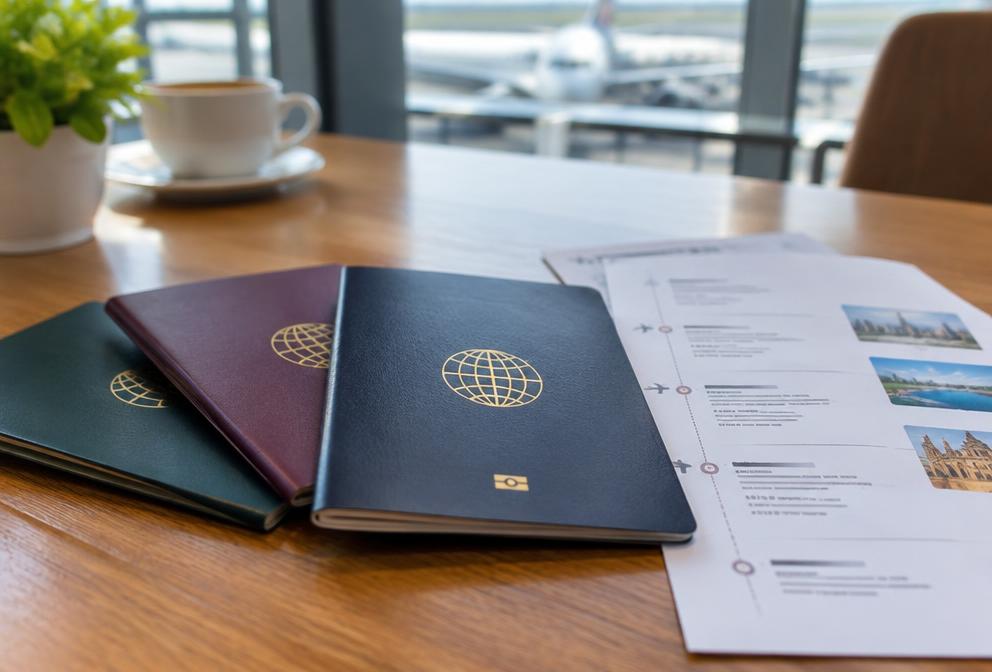
AI-generated illustration
Entry requirements and visas
The rules that apply depend in particular on nationality, passport, purpose of visit, destinations and length of stay. Different requirements may apply even within the same group.


Discover Europe together – from historic cities and famous sights to tailor-made itineraries. Information and support for planning your international group trip.
For international groups and tour operators.
Whether you are visiting Germany, touring several European countries, enjoying a cultural programme or travelling as a group on business: an international trip requires careful preparation. We highlight key destinations, typical planning steps and official sources of information on visas, passports, border checks and insurance. Use our group enquiry form to describe your preferred itinerary. Specific services, availability and prices are provided only after an actual offer has been reviewed.

AI-generated illustration

AI-generated illustration

AI-generated illustration

AI-generated illustration

AI-generated illustration

AI-generated illustration
Subject to actual availability and applicable entry requirements.
Tell us what you have in mind – we will check suitable group travel offers and possible programme elements.
AI-generated illustration
The rules that apply depend in particular on nationality, passport, purpose of visit, destinations and length of stay. Different requirements may apply even within the same group.

AI-generated illustration
Check the validity of travel documents well in advance. For most short stays in the Schengen area, passports must remain valid for at least three months after departure and must generally have been issued within the last ten years. Check whether any exceptions apply to individual cases.

AI-generated illustration
Agree on group size, luggage requirements, hotel category, central location and transfers between airports, hotels and sightseeing locations in good time.

AI-generated illustration
Confirm museums, admission tickets, guided tours, restaurants, event attendance and the preferred language for tour assistance in advance. Services are only included if expressly listed in the specific offer.

AI-generated illustration
Clarify the currency, price components, taxes, any local charges, payment methods, cancellation terms and invoice details in advance, depending on the offer.

AI-generated illustration
Consider accessibility, dietary requirements, age range, minors and rest breaks when making your enquiry.
This information provides initial guidance and is not a substitute for legally binding advice. The latest information from the relevant embassies, consulates and border authorities is always authoritative. Rules may change before departure.
Information as of: – check official sources before travelling
The Schengen area currently comprises 29 countries, including Germany, France, Italy, Spain, Austria and Switzerland. For many short stays, the overall limit is 90 days within a rolling period of 180 days – not 90 days per country. The rules on visa-free travel, multiple entries and previous stays must be checked for each individual.
This depends on nationality and individual travel documents, not simply on the region a group is travelling from. Participants subject to visa requirements may need a short-stay visa, while others may be able to travel visa-free. A group travel contract does not replace an individual visa application. Applications are generally handled by the diplomatic mission of the Schengen country that is the main destination; for stays of equal length in several countries, this is usually the mission of the first country of entry. Please check with the official authorities to confirm which mission is responsible.
Under the general EU rules, applications can be submitted no earlier than six months and generally no later than 15 calendar days before the planned trip. The standard processing time is 15 days and may be extended to 45 days in individual cases; waiting times for appointments must also be taken into account. Groups should therefore plan well in advance. The relevant diplomatic mission assesses each application individually – no one can guarantee that a visa will be granted.
Valid passport, application form, biometric photo, reason for travel or itinerary, proof of accommodation and funding, evidence of intention to return and suitable travel medical insurance; the specific checklist issued by the relevant embassy or consulate takes precedence. Schengen visa applications generally require proof of travel medical insurance with at least 30.000 EUR cover valid throughout the Schengen area.
Since 10. April 2026, the Entry/Exit System (EES) has been fully implemented at the external borders of the 29 participating countries. Entry and exit data and biometric details are recorded for many non-EU nationals on short stays. It replaces the previous routine passport stamping. Exceptions apply depending on the individual and their travel document. Important: EES is neither a visa nor an ETIAS authorisation.
According to the official EU website, ETIAS is not yet operational; applications cannot currently be submitted. Once it launches, the authorisation will be relevant to certain visa-exempt travellers. Check whether and when the requirement applies immediately before travelling, using only the official EU website.
The United Kingdom is not part of the Schengen area and has its own visa and ETA rules; you can check which authorisation is required using the official UK government service. Ireland is not part of the Schengen area and generally sets its own visa rules, and special arrangements for destinations such as Cyprus must also be taken into account. Multi-country trips must take all destinations and stopovers into account.
Anyone leaving the Schengen area during their trip and returning later may need the appropriate multiple-entry permissions. Nationals of certain countries may also need a transit visa for airport transit. Additional documents may be required for minors travelling alone or children travelling without both legal guardians.
Decide on destinations and dates
Check passports and entry requirements for each traveller
Agree on the group's size, language, mobility needs and interests
Enquire about a suitable itinerary, hotels, transfers and sightseeing
Carry out a final check of quotes, payment and cancellation terms and documents before departure
These steps describe a typical planning process; they do not guarantee a quote.
The euro is used in many, but not all countries – for example Switzerland: CHF, Czech Republic: CZK, United Kingdom: GBP.
Europe has different time zones; remember to take daylight saving time into account.
Plug types and voltage vary by country – check which adapters you need in advance.
Check charges for mobile phones from overseas with your provider in advance.
Check travel medical insurance and personal medication (preferably in its original packaging) in advance. Emergency number in the EU: 112.
Card acceptance and cash availability vary by region.
Customs vary from country to country.
Agree on meeting points, break times, emergency contacts and designated points of contact.
Tell us what you have in mind and we will check which travel options suit your group.
Only information provided by the relevant authorities is binding. The links lead to official websites.
Information as of: 19.11.2026 · Next editorial review: 19.02.2027